DNS, or Domain Name System, is one of the most important components of the internet. Every website you visit, every app you use, and almost every online service depends on DNS. Without DNS, the internet as we know it would not work.
Most users type website names like google.com or facebook.com, but computers and servers do not understand domain names. They communicate using IP addresses. DNS acts as the bridge between humans and machines.
What Is DNS?
DNS stands for Domain Name System. Its main job is to convert human-readable domain names into machine-readable IP addresses.
For example:
- google.com → 142.250.183.206
- facebook.com → 157.240.229.35
When you type a website name into your browser, DNS tells your browser where that website is located.
Why DNS Is Needed
Imagine if you had to remember phone numbers instead of contact names. The internet would be very difficult to use if users had to remember IP addresses.
DNS solves this problem by allowing humans to use names, while machines continue to communicate using numbers.
In short:
- Humans remember domain names
- Machines understand IP addresses
- DNS connects the two
How DNS Works (Step by Step)
When you type a website name in your browser, several steps happen in the background:
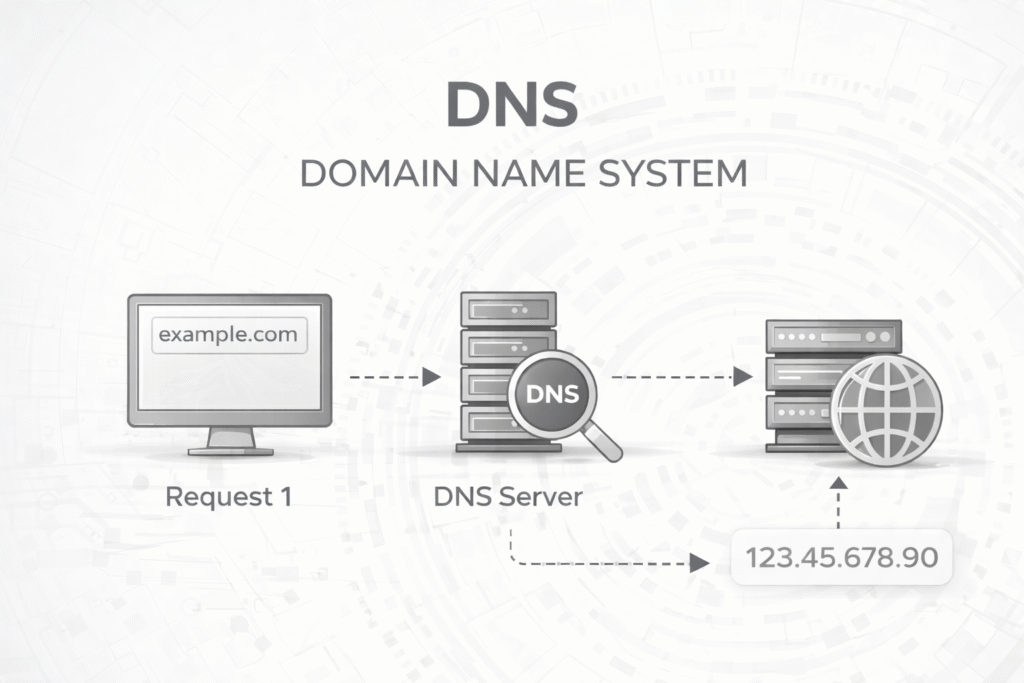
- You enter a domain name (example.com)
- Your browser checks its local DNS cache
- If not found, the request goes to a DNS resolver
- The resolver asks DNS servers for the IP address
- The IP address is returned to your browser
- Your browser connects to the server using that IP
All of this usually happens in milliseconds.
Types of DNS Servers
DNS works using multiple types of servers:
- Recursive Resolver – First point of contact
- Root DNS Server – Knows where TLD servers are
- TLD Server – Handles domains like .com, .org
- Authoritative DNS Server – Stores actual DNS records
Each server has a specific role in resolving a domain name.
Common DNS Records
DNS stores information in the form of records. Some common DNS records include:
- A Record – Maps domain to IPv4 address
- AAAA Record – Maps domain to IPv6 address
- CNAME – Alias for another domain
- MX Record – Mail server information
- TXT Record – Verification and security data
DNS in Cybersecurity
DNS plays a critical role in cybersecurity. If DNS is not properly secured, attackers can manipulate it to redirect users to malicious websites.
Common DNS-related attacks include:
- DNS Spoofing
- DNS Cache Poisoning
- Phishing via fake DNS records
- Man-in-the-Middle attacks
In such attacks, users believe they are visiting a legitimate website, but DNS sends them to a fake server controlled by an attacker.
Example of a DNS Attack
Imagine you type bankwebsite.com.
If DNS is compromised:
- DNS returns the attacker’s IP address
- Your browser loads a fake banking website
- You enter your login credentials
- Attacker steals your data
This attack happens without breaking passwords or encryption. It abuses trust in DNS.
Why DNS Security Is Important
DNS is often called the “phonebook of the internet”. If this phonebook is corrupted, everything breaks.
Organizations protect DNS using:
- DNSSEC
- Secure resolvers
- Monitoring DNS logs
- Restricting DNS changes
DNSSEC Explained Simply
DNSSEC (DNS Security Extensions) adds cryptographic signatures to DNS records. It helps verify that DNS responses are authentic and not modified.
DNSSEC does not encrypt data, but it ensures data integrity and authenticity.
DNS vs IP Address
DNS and IP addresses are closely connected but serve different purposes:
- DNS is a naming system
- IP addresses identify devices on a network
DNS makes the internet usable for humans, while IP addresses make it usable for machines.
Common DNS Misconceptions
- DNS is not a hosting service
- DNS does not store website content
- DNS does not provide encryption
DNS only provides direction, not protection.
Why Every Developer and Security Professional Must Understand DNS
Many serious security issues start with DNS misconfigurations. Understanding DNS helps in:
- Preventing phishing attacks
- Securing web applications
- Detecting suspicious traffic
- Improving incident response
Conclusion
DNS is a silent but powerful system that keeps the internet running. It works in the background, unnoticed, but any weakness in DNS can lead to serious security problems.
Whether you are a developer, system administrator, or cybersecurity learner, understanding DNS is essential.
The internet starts with DNS.
Disclaimer: This article is for educational and awareness purposes only. Do not attempt unauthorized testing or attacks on systems you do not own or have permission to test.